Jobs

...now browsing by tag


Governor’s Job Creation Proposal Includes Expanding California’s New Jobs Tax Credit

Thursday, August 25th, 2011

Governor Jerry Brown’s proposal today of an expanded tax credit for small businesses incorporates (in amended fashion) a similar proposal put forward in February by California Senate Republican Bill Emmerson of Hemet, California   (see my previous post, herein). 

Both proposals would expand an existing ”new jobs” tax credit that offered $3,000 per job created by small California businesses that employ up to 20 workers.  The proposals would expand the program’s availability to include employers with up to 50 workers.  Governor Brown’s offer, as announced today, would also increase the amount of the tax credit from $3,000 up to $4,000 per new job created.

Brown conditions this expanded yet highly-focused tax break on the passage of a controversial provision mandating the single-sales factor approach for multi-state income apportionment. 

See today’s articles in the Sacramento Business Journal and the San Francisco Chronicle.

Job Creation Task Force Called for Extending WOTC

Monday, July 25th, 2011

The Huffington Post published an article by Leo Hindery, Jr. this morning in which Mr. Hindery tells about his task force’s new report, “Vision of Economic Renewal: An American Jobs Agenda.” This report includes a series of 15 recommendations (issued by The Task Force on Job Creation) for reversing America’s economic crisis. 

The article is interesting. If you would like to know about all 15 recommendations, click through and read it.

My focus here is on the last of the 15 recommendations — extend the Work Opportunity Tax Credit (aka WOTC) including the temporary (and now expired) Disconnected Youth category.

The task force is concerned about high unemployment of America’s youth – particularly those between the ages of 16 and 24.

“The hardest hit among the unemployed are young people. Almost 25 percent of teenagers from 16 to 19 are officially unemployed. For young adults aged 20 to 24, unemployment is nearly 16 percent — a number not seen since 1948. Many of these disconnected youth are at risk of becoming permanently disengaged from the labor market. Young people who do not have a successful work experience by age 25 are also at greater risk of lifelong poverty.”

Extending WOTC with its Disconnected Youth category is one way to create more job opportunities for these young potential workers.

The task force’s credentials are impressive and might give some members of Congress a reason to pay attention.  For example, Mr. Hindery is chair of the Smart Globalization Initiative at the New America Foundation and the former CEO of AT&T Broadband and its predecessors, Tele-Communications, Inc. and Liberty Media.  

Mr. Hindery’s co-chair on the task force was Leo W. Gerard, International President of the United Steelworkers and a member of the executive council of the AFL-CIO.   The 20 person task force also included other “policy makers, economists, business and labor leaders” whose names are not mentioned in the Huffington Post article.

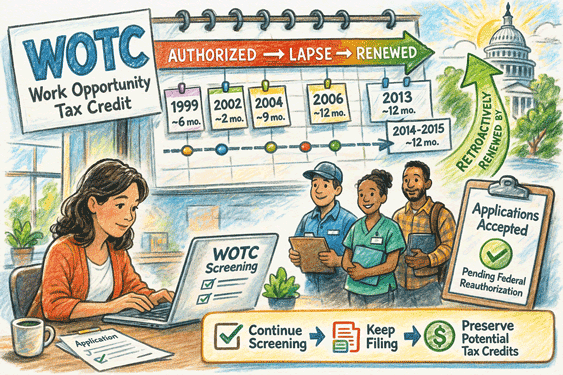
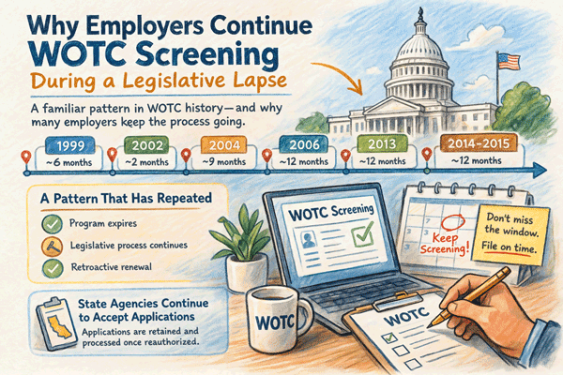
WOTC is slated to expire at the end of December 2011.  As I’ve reported previously, this is not unusual . . .  Congress has had to reauthorize WOTC eight times since it’s inception in 1996 (see previous post, The Rocky Road of WOTC).

The issue is somewhat different today, however, in that the U.S. Department of Labor recently recommended termination of WOTC – a small and misguided contribution toward reducing the national budget deficit.  I’ve seen no indication so far that any legislators are taking that recommendation seriously.   The recommendation, nevertheless, is a token of the volatile political environment we currently face.  It is an environment in which almost nothing is certain, except of course death and taxes.

Alabama Legislature Passes Full Employment Act of 2011 – New Jobs Credit for Businesses

Friday, June 3rd, 2011

Following is a recent  press release from the office of Alabama Governor Robert Bentley.

June 2, 2011

Governor Bentley Praises Legislature for Passing Full Employment Act of 2011

MONTGOMERY- Governor Robert Bentley today praised the Alabama Legislature for today’s passage of the Full Employment Act of 2011.  The Governor introduced the Act in March as his centerpiece legislation to help small businesses hire employees. The Full Employment Act of 2011, sponsored by State Representative Blaine Galliher and State Senator Arthur Orr will provide a one time tax credit to small businesses who hire additional employees.
 
“By passing this Legislation, Alabama can now help small businesses create jobs by offering a tax incentive that will grow and expand their business”, said Governor Bentley. “I commend members of the House and Senate for their hard work in passing this bill, so people in our state can get back to work. I appreciate the support of both Representative Galliher and Senator Orr to get this important bill introduced and passed in the Alabama Legislature.”
 
Under the Full Employment Act of 2011, businesses with 50 or fewer employees will receive a one time income tax credit equal to $1,000 per new job paying more than $10 per hour.  Once the Governor signs the bill into law, the tax credit will be available for newly hired employees, during the tax year in which the employee has completed 12 months of consecutive employment.  The Full Employment Act of 2011 is an enhanced version of the Reemployment Act of 2010.

Idaho Gov’s Press Release about State’s HIRE One Act

Tuesday, May 31st, 2011

Idaho’s Governor C.L. “Butch” Otter issued this oppinion piece today.  It can also be found on the Governor’s website, here.

HIRE ONE IS AN EFFORT WE ALL NEED TO SUCCEED

By C.L. “Butch” Otter

Our economy is starting to grow again, but too many Idahoans remain out of work.

That’s what I said in January in my annual State of the State address as I proposed augmenting our broader Project 60 initiative with a “Hire One” campaign encouraging Idaho’s roughly 55,000 employers to add personnel to their operations whenever possible.

Employment levels haven’t changed much in the past four months. Many Idaho companies are showing an increase in business and more profits. Financing is getting a little easier, and Idaho exports are on track to set records. Unfortunately, our jobless numbers don’t reflect the uptick in business activity. About 74,000 Idahoans are still out of work, leaving us stalled at an unemployment rate closer to 10 percent than any of us would like.

Until that situation starts improving, any talk about the economic downturn being over is premature. It certainly isn’t over for the Idahoans who are unemployed – a number greater than the total combined populations of Lemhi, Power, Teton, Boise, Caribou, Bear Lake, Lincoln, Custer, Oneida, Lewis, Adams, Butte, Camas and Clark counties.

For real growth to happen, it needs to occur at all levels, from the small businesses on our Main Streets to Idaho’s biggest employers, from our rural communities to our more urban areas, and from the Panhandle to the high desert.

I recently was very pleased to be joined by some of Idaho’s hardest-working economic development professionals, Chamber of Commerce officials and community leaders as I signed the Hire One Act, a new law passed by the Legislature that encourages and rewards businesses that add to their payrolls, and to Idaho’s future prosperity.

Hire One provides tiered, targeted, refundable income tax credits for qualifying employers who create jobs or expand career opportunities in Idaho. There are three levels of qualification for the credits based on how each employer is rated by the Idaho Department of Labor for payment of unemployment insurance taxes. Those levels in brief are:

  • New employers hiring Idaho workers will qualify for a refundable tax credit equal to 4 percent of a new employee’s gross annual wages.
  • Existing businesses with a positive unemployment insurance payment rating that add an employee would get a refundable tax credit equal to 6 percent of that new employee’s gross annual wages.
  • Existing businesses with a deficit rating that add an employee would get a refundable tax credit equal to 2 percent of that new employee’s gross annual wages.
  • Call it a bonus. Call it a reward. Call it whatever you like, but the fact is we expect the income tax credits paid out to employers will be more than fully offset by the income, sales and property taxes paid by those new employees in the workforce – not to mention the private economic activity they will generate. With minimum qualifying pay rates of $12 per hour in counties with 10 percent or more unemployment or $15 per hour in counties with jobless rates under 10 percent, and with employer-provided health insurance also required to qualify for the tax credits, we aren’t just promoting employment; we’re promoting career opportunities that can help keep a family off Medicaid or other public assistance.

    You will see more about Hire One in coming months as we reach out to businesses around the state to join in building Idaho’s economy through job growth. We soon will launch a Web site at www.hireone.idaho.gov, which will be the go-to place for businesses to get their questions answered. The Department of Commerce, Department of Labor and State Tax Commission already are helping businesses understand Hire One benefits and requirements.

    So if you’re employed, mention it to your boss. If you’re involved in a chamber of commerce, share it with your members. If you’re involved in local government, adopt Hire One as your campaign too.

    This is an effort that we all should take personally. Hire One can help get our friends, family and neighbors back to work. Right now that might be the most important step of all for Idaho’s economy, communities and citizens.

    ###

    Tennessee Job’s Credits Will Expand Under Governor’s Tax Incentives Bill

    Monday, May 23rd, 2011

    Tenessee Governor Bill Haslam’s proposals for various tax incentives were passed by the State legislature on Saturday. Reported by Tom Humphrey at www.knoxnews.com

    The underlying bill on tax incentives was characterized by House Majority Leader Gerald McCormick, R-Chattanooga, who sponsored the bill for Haslam, as “retooling our economic development arsenal.” Among its provisions:

    *    The state’s current $5,000-per-job tax credit, available to businesses creating at least 100 new jobs under prescribed conditions, will be extended to businesses creating as few as 50 jobs at a reduced rate of credits. For example, creating 50 jobs would get 50 percent of the $5,000 credit per job, or $2,500, while creation of 80 jobs would be 80 percent of the maximum credit.

    *   The tax credits now available for opening a new headquarters facility in Tennessee involving at least $10 million of investment and 100 new jobs paying 150 percent of the state’s average wage will be extended to companies expanding an existing headquarters by the prescribed amounts.

    *   Companies receiving tax credits and incentive payments will be subject to audits to ensure they actually met the criteria specified in state law. If it is found they have not complied, the companies would be subject to what McCormick called “a clawback,” forcing return of incentive money or tax credits provided by the state.

    McCormick said the net result of the incentives legislation is to “make our state more attractive to economic development and make the companies more accountable.”

    Read the entire story, here.

    Communities to Save Enterprise Zones: Statement on the Governor’s May Revision of the California State Budget

    Wednesday, May 18th, 2011

    SACRAMENTO – Communities to Save Enterprise Zones today issued the following statement from their counsel, Marty Dakessian, in response to the Enterprise Zone proposals in Governor Jerry Brown’s May revision of the California State Budget:

    “Communities to Save Enterprise Zones is strongly opposed to this new Enterprise Zone proposal,” said Marty Dakessian, counsel for Communities to Save Enterprise Zones.

    “While we continue to analyze the details of the Governor’s May revision, our initial perspective is that the Governor’s proposal with respect to Enterprise Zones is not much better than the Governor’s January proposal to retroactively repeal the tax credits,” Dakessian, who also serves as a partner with Reed Smith LLP.

    “In fact, the Governor’s new proposal amounts to an illegal billion dollar tax increase on businesses. It would effectively eliminate the program’s benefits, eviscerate its value and burden businesses by replacing it with another hoop-laden program that does nothing to benefit the budget, the economy, workers, businesses or the communities they live in,” Dakessian continued.

    He concluded, “The Governor’s new proposal is a continued attack on small business because it takes away promised benefits and penalizes employers for creating jobs in the state. It fails to recognize job retention as an important factor in our economic recovery, reduces tax credits for new jobs thereby reducing incentives for new hires, creates conflicting bureaucratic hoops that would make it difficult for business owners to collect on tax credits. Finally, because it limits carryforwards and violates the contracts clause, it is still clearly unconstitutional.”

    Communities to Save Enterprise Zones is a coalition of more than 500 local elected officials, businesses, community leaders and organizations.

    California’s Enterprise Zone Program is one of the State’s most vital programs aimed at creating jobs and reducing poverty. This program enjoys widespread support from Democrats and Republicans, businesses, chambers of commerce, taxpayers, and local government.

    Repealing the Enterprise Zone Program will harm the very communities that are hurting the most in this recession, would amount to an increased tax on businesses, and is illegal because it would violate the Due Process and Contracts clauses of the United States Constitution.

    ##

    CA Governor’s EZ Proposal Not So Good After All

    Tuesday, May 17th, 2011

    Details from the CA Governor’s May Budget Revision, released yesterday, are now hitting the news. What we thought was potentially good news for the state’s enterprise zone program (based on Friday’s leak), is not what we are hoping for.  As you consider this news, do not simply assume Governor Jerry Brown’s proposals will be adopted. 

    We’ve already seen legislators supporting the enterprise zone program from both sides of the political aisle.  Governor Brown’s proposals, on the other hand, are draconian and unlikely to sway many into supporting his anti-enterprise zone views.

    The Governor’s office is proposing radical and unworkable changes to the enterprise zone program – very much unlike the meaningful reforms proposed by Democrat Assemblyman V. Manuel Pérez.

    The following quotes are directly from the budget summary released by Governor Jerry Brown’s office.

    “Instead of repealing state tax benefits for Enterprise Zones, the May Revision proposes to reform Enterprise Zone hiring credits so that credits are only available to firms which actually increase their level of employment. Taxpayers would be eligible for a $5,000 credit for each incremental full-time equivalent employee that they hire.”

    Response: Frequently, firms struggling to operate in economical depressed area of the state can neither hire full-time employees nor increase their level of employment. This is especially true of the smallest businesses.

    While most business owners want to expand, too many are struggling to survive. Even while they struggle, however, they provide jobs for grateful employees who otherwise would join the ranks of the unemployed. The populations within some of California’s enterprise zones are currently experiencing unemployment rates of more than 20%.

    “These credits would only be allowed if claimed on the taxpayer’s original return.”

    Response: In other words, an employer cannot file an amended return to claim credits that were missed. This unfairly discriminates against business owners who may not have the immediate time or means to win this race against the clock — to comply with all the program’s procedures and stipulations before their tax return is due.

    “Additionally, the May Revision proposal would not allow any new vouchers to be granted for tax years prior to 2011 when the application for that voucher was made more than 30 days after the date that the employee first begins employment.”

    Response: This proposal is completely unworkable and probably exposes an ignorance of enterprise-zone program realities. Unless other regulation and documentation standards are also revised, in most cases it is NOT possible to submit a complete application within 30 days of hire.

    Even someone who knows the program very well – and knows the secrets to obtaining hard-to-get documentation – will be pressed to complete an employee application in 30 days. In most cases, it is impossible unless an employee is able to provide what is needed from his or her own personal files  (and this is rare).

    “Additionally, to ensure that credits are creating incentives for relatively profitable, tax-paying businesses, the Enterprise Zone credits will be limited to a five-year carry-forward period.”

    Response: Limiting to a 5-year carry forward period plainly contradicts the previously stated goal of reforming the program so “that [hiring] credits are only available to firms which actually increase their level of employment.”

    Expanding businesses – the ones that increase the size of their workforce – frequently experience losses during the short-term as they invest in their workforce and other assets. Then, as the investments begin the pay off, those operating losses also carry forward and offset the company’s tax liability during its initial year(s) of profitability.

    The Governor’s proposal contradicts itself by encouraging expansion with a hiring tax credit but then limiting its use to a five-year period – during which the company is least profitable and least in need of tax savings.

    Small Business Encouragement Act Looks . . . Encouraging

    Saturday, May 7th, 2011

    The federal Small Business Encouragement Act – HR 1663, if it were to become law, would offer the largest federal hiring credit available today.  Here’s the release from the website of Rep. Allen West (FL-22).

    Congressman West Introduces the Small Business Encouragement Act
    (Washington)—Congressman Allen West (FL-22) announces today bipartisan legislation that will put Americans back to work by helping our nation’s most effective job creators, our small businesses. 

    HR 1663- The Small Business Encouragement Act- aims at amending the Internal Revenue Code to allow small businesses who hire an unemployed American, a work opportunity tax credit, saving employers up to $12,000 a year per hire in some areas of the country.

    To qualify, small businesses must have gross receipts in the preceding taxable year not exceeding $20 million, or they must employ less than 100 full time employees.

    The tax credit will double for employers hiring unemployed Americans in counties with an unemployment rate that is higher than the national average, which is currently just above 9 percent.

    “In my Congressional District of Florida, unemployment is still hovering around 11 percent.  This is unacceptable and the administration of President Barack Obama has offered very little solution for digging us out of this mess,” West said. ”The Small Business Encouragement Act is a simple, effective solution to putting people back to work by encouraging the very backbone of our economy, the small businesses.”

    Employers seeking the tax credit will be required to hire unemployed individuals for at least one year, full-time, with a start date during or after January, 2012. The credit will also extend for employers hiring unemployed Americans in 2013.

    *Members of Congress who have already co-sponsored this legislation include:
                        
     Marsha Blackburn (TN-07) 
     Joe Walsh (IL-08)
     Ron Paul (TX-14)
     Laura Richardson (CA-37)
     Scott Rigell (VA-02)
     Ileana Ros-Lehtinen (FL-18)
     Dennis Ross (FL-12) 
     C.W. Bill Young (FL-10) 
     Steve Stivers (OH-15) 
     Wm. Lacy Clay (MO-01) 

    Also supported by:

    Business Coalition for Fair Competition 
    National Black Chamber of Commerce 
                       
                                                                    ###

    More on Idaho’s Hire One Act – Gov Signs Bill Into Law

    Thursday, April 14th, 2011

    Idaho Governor Butch Otter signed the Hire One Act into law Wednesdayin a public ceremony.  KTVB.com carried the story with a short video.

    The Spokesman-Review also carried an article yesterday that included a short summary of the program:

    Under the bill, for-profit Idaho employers who make new hires on or after April 15 – this Friday – would be eligible for a tax credit if the jobs include health benefits and pay at least $12 an hour in counties where employment is above 10 percent, or $15 an hour in counties where it’s below 10 percent. The amount of the credit would vary from 2 to 6 percent of the new worker’s gross wages, based on the employer’s rating in the state unemployment insurance program; that’s to ensure that employers who laid off workers during the recession and are just now hiring them back aren’t rewarded as much as those who kept their workers on, and now are expanding.

    The refundable tax credit expires on Jan. 1, 2014.

    California Republican Party Adopts Resolution Opposing Elimination of Enterprise Zones

    Sunday, March 20th, 2011

    According to a press release issued today by Californians for Jobs and Safe Communities, the California Republican Party passed a resolution this weekend urging Republican legislators to:

    vote to oppose the elimination of the California Enterprise Zone Tax Credit Program and look for further ways to expand tax credit programs to spur economic growth.

    The party held its spring convention this weekend in Sacramento. According to the press release, the resolution received unanimous support from Republicans in committee during the convention on Saturday.

    As of this hour on Sunday, the resolution is not mentioned on the Republican Party website; however, the full text was included in the press release, as follows:

    Resolution Opposing Governor Brown’s Ill-Conceived Attempt to Eliminate California’s Enterprise Zone Tax Credit Program

    Submitted by the Honorable George Runner

    For consideration at the Spring Convention of the California Republican Party

    Sacramento, California

    March 18-20, 2011

    Whereas, California businesses are struggling with economic recovery, burdensome regulations and high state taxes in the midst of the national economic downturn keeping unemployment at record high levels.

    Whereas, Governor Jerry Brown – elected in November 2010 – promised to spur job creation and make California business friendly now proposes to eliminate one of the most successful programs that actually has created jobs in more than 40 communities across the state: the Enterprise Zone Tax Credit Program.

    Whereas, California’s landmark Enterprise Zone Tax Credit Program is an economic driver that has been proven to create jobs, spur economic development and keep businesses open.

    Whereas, in 2010 the program created or retained more than 118,000 jobs statewide while providing employment opportunities for more than 415 veterans returning home from serving our country.

    Whereas, in 2010 the program saved California’s taxpayers an estimated $211 million by providing work instead of welfare and paychecks instead of unemployment benefits to more than 23,000 citizens.

    Whereas, the California Enterprise Tax Credit Program and other proven job creators should be expanded, not eliminated.

    THEREFORE BE IT RESOLVED BY THE CALIFORNIA REPUBLICAN PARTY that members of the Legislature vote to oppose the elimination of the California Enterprise Zone Tax Credit Program and look for further ways to expand tax credit programs to spur economic growth.