President Barack Obama

...now browsing by tag


If Republicans “Take the Deal” WOTC and Extenders Will Renew for 2012, 2013

Wednesday, December 19th, 2012

President Obama’s remarks this morning on his “fiscal cliff” negotiations with House Republicans signals optimism that a deal may be close.  Both sides have made concessions but continue to push for additional concession from the other. Near the end of his remarks this morning, the President said,

“I remain optimistic, because if you look at what the speaker has proposed, he’s conceded that income tax rates should go up . . . I’ve said I’m willing to make some cuts. What separates us is probably a few hundred billion dollars. The idea that we would put our economy at risk because you can’t bridge that cap doesn’t make a lot of sense.”

And a little later,

At some point there’s got to be I think a recognition on the part of my Republican friends that, you know, take the deal.

Read the entire transcript in the Washington Post.

Paul Suplizio, President of the WOTC Coalition, took in the Presidents remarks today.  We have his observations, published here with permission.

**********

From: Paul Suplizio
Sent: Wednesday, December 19, 2012 10:14 AM
Subject: President Tells Republicans, “Take The Deal”

December 19, 2012

12:41 PM EDT

President Obama took questions on the fiscal cliff at his press conference today.

He said he’s reaching out to Republicans and understands their difficulty, but he’s met them half-way, “So, take the deal!”

These comments came after the White House issued a statement saying the President would veto Plan B, and The Speaker’s office replied, “Statements from the White House are increasingly irrational.”

A vote on Plan B is scheduled for tomorrow (Thursday) in the House; to pass a bill before Christmas, a deal needs to come Thursday night or Friday.

If there’s no deal, expect Congress returning and negotiations continuing after Christmas.

To clarify the situation: if Republicans take the President’s latest offer, WOTC and tax extenders would be renewed for 2012 and 2013.

PAUL E. SUPLIZIO
President, WOTC Coalition


Negotiation Gap Narrows as Obama’s Offers Continue to Include WOTC

Tuesday, December 18th, 2012

As the tax and spend negotiations continue, President Obama’s most recent offer on Monday included an extension of the Work Opportunity Tax Credit program and other tax extenders.  This has been consistent while the public focus of the negotiations has been on areas of deeper disagreement. Already this morning, the White House rejected House Speaker Boehner’s counter offer.

We have correspondence this morning from Paul Suplizio, President of the WOTC Coalition, with encouragement for those hoping to see the tax extenders included in any compromise hammered out by House Republicans and the Obama Administration.  Our emphasis for action should be to build a “pro-extenders’ fire under House Republicans and their leaders.”

The following is published here with permission.  (Emphasis in bold is from the original.)

*******

From: Paul Suplizio
Sent: Tuesday, December 18, 2012 5:38 AM
Subject: President Makes Comprehensive New Offer Including Tax Extenders

December 18, 2012

Yesterday, the President proposed a 39.6 percent marginal rate on income of joint tax filers above $400,000, withdrawing his previous demand to apply that rate to income above $250,000.

This latest offer to Speaker Boehner is part of a comprehensive deficit-reduction package that includes extension of WOTC and other tax extenders.

The Speaker isn’t satisfied with the offer and negotiations are continuing. The Speaker will meet with House Republicans this morning to report on the talks and get their reaction.

The President’s offer includes a 20 percent tax rate on capital gains and dividends, up from the current 15 percent, and a 45% estate tax (Republicans want the rate to be no more than 35%).

The President wants $50 billion in infrastructure spending, $30 billion to extend unemployment benefits, permanent AMT relief, and permanent Medicare doctors’ relief from scheduled cuts.

On entitlements, the President proposed using the so-called “chained CPI” for annual Social Security and pension cost-of-living increases, plus other savings in entitlement programs.

On spending, the sequester would be delayed and there would be further cuts in discretionary programs including defense.

The President wants the right to set the debt ceiling for another two years under the McConnell rule. The Speaker has already offered one year.

No other details are available on the tax extenders except they continue to be included in each offer made by the President.

Please continue your contacts. These talks could go till the end of the month—we need to continue building a pro-extenders’ fire under House Republicans and their leaders.

PAUL E. SUPLIZIO
President, WOTC Coalition

Something to Watch – Today’s Obama Interviews May Provide a Breakthrough on Tax Extenders

Thursday, December 13th, 2012

President Obama’s  TV interviews scheduled for today may provide fuel for a potential breakthrough in tax and spending talks, according to Paul Suplizio, President of the WOTC Coalition.  WOTC and numerous other tax provisions hang in the balance . . . although failure now may still be rectified after the new year.

“The President’s interview at 5 PM today could break the deadlock if he mentions specific entitlement cuts of around $500 billion. If that doesn’t work nothing will. . . .”

The following correspondence from Paul Suplizio is published here with permission.

*******

From: Paul Suplizio
Sent: Thursday, December 13, 2012 10:58 AM
Subject: Obama Interview At 5:00 PM EDT Today May Attempt Breakthrough

December 13, 2012

The $200 billion “stimulus package” in the President’s offer was repeated two days ago without an affirmative reply by Republicans—this is the package that carries WOTC and other tax extenders.

Speaker Boehner has attacked the stimulus package because it adds to the deficit; he leans against making it part of a fiscal cliff deal unless he can get bigger spending cuts. Our lobbying aims to persuade him to accept WOTC and other extenders, which now include bonus depreciation and energy extenders that expire at the end of the month.

In his latest offer, the President reduced his tax revenue target from $1.6 to $1.4 trillion, and the Speaker countered with his original offer of $800 billion. Nevertheless, the White House is confident Republicans will eventually accept higher tax rates on the wealthy—the main issues they see now are entitlements, the stimulus package, and raising the debt ceiling.

A major factor is whether the Speaker can get a majority of Republicans to vote for whatever deal he makes with the President. The White House doesn’t want to offer major entitlement cuts that will make Democrats unhappy, only to see the deal rejected by the Republican caucus in the House.

The President’s interview at 5 PM today could break the deadlock if he mentions specific entitlement cuts of around $500 billion. If that doesn’t work nothing will, because in the deal that’s on the table now, Republicans will come away with better tax rates on upper incomes, capital gains, dividends, and estates than if there’s no deal and Bush tax cuts expire.

In sum, if there’s a fiscal cliff deal, there’s a solid chance WOTC and the extenders will be included.

If there’s no deal, Republicans are talking about returning after Christmas and passing the Senate bill that extends the Bush tax cuts for incomes up to $250,000. This would not be helpful on many fronts—it would leave WOTC, other extenders, payroll tax relief, unemployment compensation, bonus depreciation, Medicare doctors’ compensation, estate tax, and many other issues in limbo—not dead, but in limbo, to be taken up again in the new Congress that begins January 3rd.

There’s a chance that can be avoided, however. If Republicans in the House are ready during the final week to pass the Senate extension of Bush, it’s entirely within the province of the House leadership to craft an amendment to the Senate bill dealing with any or all of these high-priority issues that would otherwise be left unattended.

It would require a degree of legislative initiative that hasn’t been a hallmark of this House. The Leaders’ problems in winning consensus among Republicans still makes for paralysis in decision and no action rather than action. This is why we must continue hammering away at our House Republican congressmen, urging them to spur their Leaders to action on WOTC and your other issues. If we want action on the Hill, we ourselves need to act, everything starts with us!

Many thanks to so many of you who are dedicating time and effort to the campaign. It has been a pleasure cooperating with you.

PAUL E. SUPLIZIO
President, WOTC Coalition

House Divided Over Tax & Spend Options – Tax Extenders Are Negotiable

Thursday, December 6th, 2012

A precarious moment has arrived for extending the Work Opportunity Tax Credit (WOTC) and other tax extenders.  Republican leadership has expressed their general opposition to the $200 billion in “stimulus” included in President Obama’s budgetary demands.  The Republican leadership has not specifically mentioned the $40 billion in tax extenders BUT the extenders (including WOTC) are part of the larger $200 billion stimulus package.

During the  next few days, many Republican House members will be visiting their home districts.  As Paul Suplizio, President of the WOTC Coalition exhorts in his most recent correspondence to WOTC Coalition members, now is the time to contact your Republican Representative and urge him or her to support the extenders.

The following is published here with permission.

********

From: Paul Suplizio
Sent: Wednesday, December 5, 2012 1:41 PM
Subject: Action Required For WOTC As House Adjourns Until Tuesday, Dec 11

December 5, 2012

Most House members will be in their districts from Thursday, Dec 6th until Tuesday, December 11th as Speaker Boehner sent members home today after a contentious meeting with his caucus on fiscal cliff negotiations. This is an important break enabling all of us represented by a Republican congressman to call his or her office for a meeting to urge the importance of including a WOTC extension in any fiscal cliff deal with the President. While a meeting may not be opportune, you may at least be able to get our message through to the congressman by phone. Congressmen do not have to return to Washington until 6:30 PM this coming Tuesday.

Here is a wrap-up of developments. The President and Speaker have spent the past two days talking to governors and high-level business leaders whose message is, “Make a decision and make it soon—the uncertainty is brutal!”

Republicans are divided over the offer made by their leaders—not only the Speaker and Majority Leader but their Vice Presidential nominee Congressman Ryan—to raise $800 billion in tax revenue by capping tax credits and deductions, while not raising tax rates. Speaker Boehner has made no bones about his going into a tough negotiation and he wants backing for whatever deal he brings back. He’s stripped four Republicans of choice committee assignments for not backing the Party when they don’t get their way.

Things are shaping up as follows. Both parties are ready to “make a down payment on deficit reduction” and defer a longer-run plan for fiscal stability to next year.

What would a “down payment” deal consist of?

The President is sticking by his demand to raise tax rates on top earners—he’s willing to negotiate how much the rates increase. The President’s proposed tax hikes on capital gains, dividends, and estates would be part of the negotiation.

On spending, the President is ready to make cuts in entitlement programs and discretionary spending. Republicans say these cuts ought to be twice the amount the President has offered ($1.2 trillion rather than $600 billion) but Republicans haven’t specified where they would cut. The President’s cuts in Medicare, Medicaid, and Social Security are in his FY 2013 budget, and that’s his starting point.

The President today made raising the debt ceiling part of his bottom line demands, saying a renewed struggle would be a “catastrophe” for the markets, threatening the full faith and credit of the government. This is bound to be negotiated.

What about the $200 billion in “stimulus” measures for 2013 that the President has made part of his demands? This package includes renewal of WOTC and other tax extenders, payroll tax relief, extended unemployment compensation, AMT relief, “doc” fix, extensions of the child tax credit and improvements in the earned income tax credit—all are negotiable and will either be included in the deal or carried over.

The $200 billion revenue loss lowers the total amount of deficit reduction in any deal, and House leaders have expressed opposition to this in their letter-offer. The position of the House on $40 billion package of tax extenders is what we are trying to turn around in our lobbying, so we continue to exhort you to contact Republican congressman and urge him to ask his or her leaders to support extension of WOTC and other expired or expiring tax provisions in negotiations with the White House.

WOTC and other extenders must be in the deal where the revenue loss will be offset by spending cuts, complying with the PAYGO law while keeping the tax-writing committees from having to raise revenues that could hurt members of our Coalition.

At this point, what we know for certain is all the extenders are negotiable and at some point in the next week or so, serious talks will begin on whether to include them or not. The talks may continue till the last minute, but that means we have only this week and next—at most—to persuade House leaders to take the President’s offer on WOTC and the tax extenders.

Therefore the task before us is clear: we ought not slacken, but let’s re-double our efforts to connect with Republican congressmen, as they are the best conduits to Speaker Boehner and other House leaders to persuade them of the political importance of including WOTC and the tax extenders in a fiscal cliff deal with the White House. You must get your Republican congressman to commit to contacting Speaker Boehner and other leaders with this message.

Many thanks to all for your hard work and commitment to the campaign. I can be reached at 703-587-4566.

PAUL E. SUPLIZIO
President, WOTC Coalition

Democrats Favorable to Including Bi-Partisan Extenders Bill in Next Tax Bill

Thursday, November 15th, 2012

Some rough politics are on the horizon as Congress tries to divert the U.S. economy’s path away from the 2013 fiscal cliff.  A small but not unimportant element in this effort is the passage of a tax extenders bill covering WOTC, empowerment zones and renewal communities, the research and development credit, and others similar tax incentives.

This morning, our friend, Paul Suplizio (President of the WOTC Coalition) offered some constructive feedback and advice to businesses and lobbyists who favor passage of  tax extenders.   His comments come in the wake of President Obama’s recent press conference.

The following correspondence is published here with permission.

*****

From: Paul Suplizio
Thursday, November 15, 2012 4:13 AM
Subject: Obama Demands Passage Of Tax Bill First

November 15, 2012

President Obama argued forcefully at his press conference yesterday to pass the tax bill first, as part of a “fiscal cliff” deal, and deal with spending issues later.

Claiming the election yielded a mandate for middle class tax relief and higher rates for the wealthy, the President insisted on ending the Bush tax rates “for people who don’t need them.”

Clearly, your Coalition wants any tax bill that emerges to carry an extension of WOTC and other tax extenders along lines of S.3521, the bi-partisan Baucus/Hatch “Family and Business Tax Cut Certainty Act.” We are getting a favorable reception from Senator Reid, Senator Baucus, and other Senate and House Democrats for adding S.3521 to whatever tax bill or bills start moving.

Treasury is pushing hard for settling the question of tax rates and benefits before December 31st so IRS and taxpayers won’t be in the dark when filing their 2012 returns. The IRS Commissioner has written Congress again urging prompt action, saying more than 60 million taxpayers—about half of all filers—will be affected if Congress fails to act.

We should be pressing Republican senators and congressmen to make sure WOTC extension is included in any bill to extend the Bush tax cuts. Our approach should be sensitive to the fact that both Republican leaders—Speaker Boehner and Senate Minority Leader McConnell—are opposed to raising tax rates on the wealthy and will be making that case when they meet with the President tomorrow. This issue takes precedence for Republicans, WOTC and the tax extenders aren’t on their front burner right now.

Still, we have to use the lobbying time available, and it’s precious little. To Republicans in the Senate and House, we can still be pressing our message, “A million jobs are at stake in WOTC extension, we need your help to make sure WOTC won’t be forgotten in any deal on the Bush tax cuts, or in any bill brought by the Ways and Means Committee.”

A transcript of the President’s press conference is available at www.whitehouse.gov, click on “Briefing Room” and then “Speeches & Remarks.”

Here’s the nub of his message:

“And so the most important step we can take right now is if we right away say 98 percent of Americans are not going to see their taxes go up; 97 percent of small businesses are not going to see their taxes go up. If we get that in place, we are actually removing half of the fiscal cliff. Half of the danger to our economy is removed by that single step. And what we can then do is shape a process by which we look at tax reform—which I’m very eager to do. I think we can simplify our tax system. I think we can make it more efficient. We can eliminate loopholes and deductions which have a distorting effect on our economy. . . .

“Can we all step back and say, here’s something we can agree on—we don’t want middle class taxes to go up? Let’s go ahead and lock that in. That will be good for the economy. It will be good for consumers. It will be good for business. It takes the edge off the fiscal cliff. And lets also then commit ourselves to the broader package of deficit reduction that includes entitlement changes and it includes potentially tax reform . . .”

PAUL E. SUPLIZIO
President, WOTC Coalition

The WOTC Program’s Reauthorization Delay – Participating in the Interim

Wednesday, May 23rd, 2012

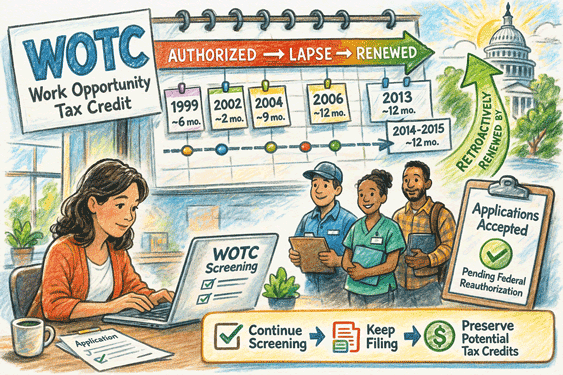
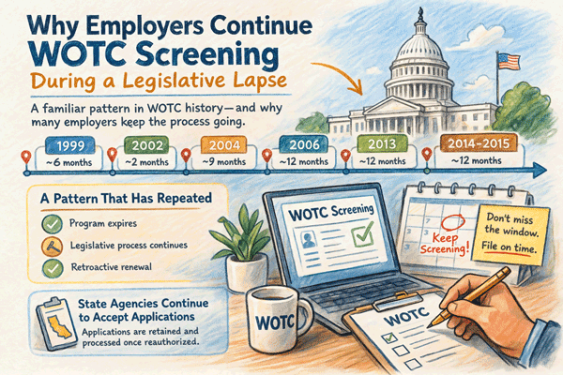
A Little History: This is Nothing New. The Work opportunity Tax Credit (WOTC) was created by the Small Business Job Protection Act of 1996. This Act authorized WOTC for a 12-month period. Then, in 1997, WOTC was re-authorized and extended for 9 months, followed by an additional 12 months in 1998. This process of expiration and re-authorization has been repeated by Congress nine times during the past 12 years.

Because of the political process, Congress has sometimes been delayed in its reauthorization of the WOTC program. In 2002, 2003 and 2006, the reauthorization was delayed as much 3, 10, and even 12 months after the program’s most recent authorization had expired. In each case, however, the program was then reauthorized retroactively back to the previous expiration date so that there has been no break in the continuity and availability of the tax credits.

Continued Screening and Processing vs. Losing Tax Credits. During these delays in reauthorization, the U.S. Department of Labor issues guidelines that have enabled employers and the government offices that administer the program to remain active in processing WOTC paperwork and applications. This has always involved some risk, however, since Congress is not obligated to renew the program.

On the other hand, employers who choose to delay the survey and application process loose their tax credits. They are lost because even during the temporary breaks in legislative authority, the program’s 28-day employee application deadline still applies. Employee applications submitted after 28 days are rejected by the WOTC program in each state.

Currently, we are experiencing a similar delay. The legislation that authorized major parts of the WOTC program expired on December 31, 2011. However, at about the same time, a very specialized bill was signed by President Obama that reauthorized and expanded the part of WOTC that generates tax credits when a business hires qualifying military veterans. This bill was called the VOW to Hire Heroes Act.

As a result of the VOW to Hire Heroes Act, some parts of WOTC are currently authorized while other parts are experiencing the now-common delay in reauthorization. As in all previous cases, friends in Congress are working to reauthorize the entire WOTC program. My firm is screening for ALL potential qualifiers influenced by the hope that the remaining employee-eligibility categories will also be reauthorized.

As a final note, Congressional reauthorization of WOTC has no impact on most state hiring credit programs. These remain effective and available even during the delay affecting WOTC.

For more information, see the Department of Labor’s Training and Employment Guidance Letter (TEGL) 15-11 dated January 24, 2012.


NEW WOTC Forms, Electronic & FAX Filing and Transition Relief

Wednesday, February 15th, 2012

Catching up with the VOW to Hire Heroes Act, which was signed by President Obama in November of last year, the Internal Revenue Service has issued an updated Form 8850 and some very important guidance.

Links for your convenience:  The new IRS Form 8850.  IRS 8850 Instructions.  IRS Notice 2012-13

Disconnected Youth: Although not unexpected, I should note that in preparing the updated IRS 8850 Pre-screening Notice, the IRS has removed the questions related to qualifying Disconnected Youth.  This category expired on December 31, 2010. 

We’ve been clinging to the hope that it would be added-back with the extension of WOTC.  I personally have not given up on that hope.  Also, if I am not mistaken, the Department of Labor’s current instructions to State Workforce Agencies still requires them to reserve disconnected youth applications on file pending future instructions.

Notice 2012-13: Notice 2012-13 provides guidance on a number of important issues and should not be overlooked.  I suggest a thorough reading.  Major topics covered include:

  • Background of the new veterans categories
  • Transition relief (a grace period extending the 28-day submission deadline for IRS 8850 for qualified veterans hired between November 22, 2011 and May 22, 2012)
  • The use of electronic signatures for IRS 8850
  • Signing or filing IRS 8850 by FAX transmission
  • Guidance for tax-exempt organizations claiming WOTC

Request for Comments: In addition to the guidance provided by the IRS on these topics, the IRS is also requesting comments about (1) alternative methods for certification of qualified veterans and (2)alternative methods of filing Form 8850.

In summary, with this notice the IRS has given us a lot to think about and a lot of work to do. 

President Obama Signs Veterans’ Hiring Credit Bill

Monday, November 21st, 2011

The VOW to Hire Heroes Act was signed today by President Obama.  (see Business Week article from today.)  As previously mentioned, this bill expands the eligible-veterans categories under the Work Opportunity Tax Credit (WOTC) program and extends the new categories through December 31, 2012. Unless the legislative language was modified prior to final passage, my understanding is that the new WOTC categories will become effective immediately.

Employers now have a job to do – update their WOTC screening tools to identify and document new hires who are members of the newly-targeted veteran groups. Any immediate changes, however, should be made with the understanding that the Department of Labor and IRS will also be updating WOTC regulations, documentation standards, and official WOTC forms. The last time significant changes were made to the WOTC program, it took months and multiple attempts for the government to finalize these changes.

In this regard, I should note that the bill includes language granting some degree of discretion to the Department of Labor when it comes to defining the documentation  requirements for the new categories.  On its face, the bill looks to a veteran’s unemployment insurance compensation history to document the required level of unemployment.  We hope, however, that other approaches will also be approved since not every unemployed veteran will necessarily have been eligible for unemployment insurance compensation.

Now that this bill has been signed by the President, I feel good about digging into the details of its legislative language. Stay tuned for further exploration and explanations.

Obama Jobs Proposal Includes Significant Hiring Based Tax Reductions

Friday, September 9th, 2011

As far as I know, no one has seen the nitty gritty of President Obama’s jobs proposal (as outlined in yesterdays speech), because legislation to implement the proposals has not yet been offered. According to articles published after the speech in the New York Times, Los Angeles Times, and San Francisco Chronicle, we do have estimates of the dollar amounts involved.

The plan in total is worth about $447 billion.  Tax cuts make up $245 billion of that, meaning actual spending proposed comes to about $200 billion.

Here’s a summary from the San Francisco Chronicle.

Employers: Payroll taxes would be cut in half for small employers in the next year and would be waived if employers create new jobs or raise their employees’ wages.

Workers: The 2 percent payroll tax cut for workers, approved in 2009, would be raised to 3.1 percent, cutting employee payroll taxes a total of 50 percent for an estimated 160 million American families.

Infrastructure: The federal government would spend more than $100 billion on infrastructure projects such as roads, bridges and high-speed rail.

Schools: The plan allocates $30 billion to upgrade 35,000 schools, plus $10 billion to establish an “infrastructure bank” to help finance local projects.

Jobless benefits: Long-term unemployment benefits would be extended and the program revamped to allow out-of-work Americans to earn pay for up to nine weeks of job training. 

Rehiring: States and local governments would receive $35 billion to rehire laid-off teachers and first responders. 

Hiring: Businesses would receive tax credits to hire long-term unemployed people

 Missing from this description is any mention of the Work Opportunity Tax Credit; however, if my memory serves me, President Obama’s speech did mention tax credits for hiring military veterans – a clear allusion to his previous touted Returning Heroes and Wounded Warrior Tax Credits. And that, of course, is an augmentation of existing credits offered through WOTC.

Given the current climate in Washington, I’m not certain if support from President Obama is helpful or harmful to the goal of extending hiring tax breaks like the WOTC program.

President Obama Pushes WOTC Expansion to Help Wounded Warriors and Returning Heroes

Friday, August 5th, 2011

Poster from Department of Veterans Affairs

This morning during a speech at the Washington Navy Yard, President Obama took notice of high unemployment among US military veterans. Although he did not mention the Work Opportunity Tax Credit (or WOTC) by name, he described two new or expanded hiring tax credits obviously designed to fit into the WOTC rubric.

Rebecca Kaplan of the National Journal published an article describing the event this morning.   The White House also published a fact sheet yesterday describing the proposals in some detail.

Thankfully, the Obama Administration has given the proposed tax credits exciting new names!  From the White House’s fact sheet:

 ******************************

Returning Heroes and Wounded Warrior Tax Credits

Under the Recovery Act, employers who hired certain unemployed veterans were eligible for a tax credit of up to 40 percent of the first $6,000 of wages, for a maximum credit of $2,400. This credit expired at the end of 2010.

The President will call for two new tax credits:

The Returning Heroes Tax Credit is a new hiring tax credit that will provide an incentive for firms to hire unemployed veterans.

* Short-term unemployed: A new credit of 40 percent of the first $6,000 of wages (up to $2,400) for employers who hire veterans who have been unemployed at least 4 weeks.

* Long-term unemployed: A new credit of 40 percent of the first $12,000 of wages (up to $4,800) for employers who hire veterans who have been unemployed longer than 6 months.

The Wounded Warrior Tax Credit will double the existing tax credit for long-term unemployed veterans with service-connected disabilities.

* Maintain the existing Work Opportunity Tax Credit for veterans with service-connected disabilities (currently the maximum is $4,800).

* A new credit of 40 percent of the first $24,000 of wages (up to $9,600) for firms that hire veterans with service-connected disabilities who have been unemployed longer than 6 months.

The paperwork process for claiming these credits will be simplified by streamlining the burdensome certification that firms had to undertake to claim previous credits.

 *******************************

As I reported previously, President Obama’s administration has expressed his support for extending the WOTC program at least through 2012.  

Interestingly, the last comment from the Fact Sheet about “streamlining the burdensome certification” process for these veteran categories appears to be an allusion to HR 2082 or the Work Opportunity Credit Improvements Act. 

Section 3 of HR 2082 is titled “Alternative Certification for Certain Targeted Groups.”  If enacted, Section 3 would sometimes allow employers to bypass the formal WOTC certification process although complete documentation of an employee’s eligibility would still be required.

HR 2082 does not (yet) include the new veteran categories offered by the White House; however, the obvious allusion to the existing bill’s streamlining provision suggests there may have been some coordination in the matter.   This should provide additional fuel for WOTC advocates supporting passage of HR 2082.