VOW to Hire Heroes Act of 2011

...now browsing by tag


White House Reiterates Proposal for Permanent WOTC Program

Wednesday, May 1st, 2013

As reported earlier this month, the 2014 fiscal budget as proposed by the White House includes a proposal to make the VOW to Hire Heroes tax credits permanent.  It would accomplish this by giving permanency to the entire Work Opportunity Tax Credit (WOTC) program — of which the VOW tax credits are an integral part.

During a veterans’ employment event at the White House on Tuesday, President Obama reiterated that proposal.

Obama noted that he has proposed a permanent extension of a tax break that Congress approved in late 2011. Employers get up to a $5,600 tax credit for hiring a veteran out of work for more than six months, or up to $9,600 for hiring a disabled veteran out of work for the same amount of time

Read more:

WashingtonPost: White House musters U.S. firms to hire veterans, spouses

MSNBCMore jobs for vets, cheers Michelle Obama, but ‘there’s more work to be done

SeattleTimesPresident, first lady ask companies to hire vets

Senator Schumer Extols Extension of VOW to HIRE Veteran WOTC Target Groups

Friday, January 4th, 2013

An article published today in The Saratogian by Paul Post outlines the recent renewal of the Returning Heroes and Wounded Warriors tax credits (as target groups within the Work Opportunity Tax Credit program).  The so-called American Taxpayer Relief Act of 2012 reauthorized the WOTC program through December 31, 2013.

Senator Charles Schumer, a Democrat from New York, has been a noted supporter of the WOTC program and the related veteran target groups.

“There are far too many veterans in New York and across the country without jobs, and these tax credits for businesses to hire veterans are a proven remedy in addressing that unfortunate truth,” U.S. Sen. Charles Schumer, D-N.Y., said. “Had the Returning Heroes and Wounded Warrior Tax Credits been allowed to expire, New York businesses and veterans alike would have lost a critical tool in getting smart and talented veterans to work.”

This article lists some interesting statistics describing unemployment among recent veterans.

The unemployment rate for veterans who served on active duty in the Armed Forces at any time since September 2001 was 12.1 percent in 2011. The jobless rate for all veterans was 8.3 percent.

Twenty-six percent of Gulf War-era II (2001-11) veterans reported having a service-connected disability in August 2011, compared with about 14 percent of all veterans.

Young male veterans, ages 18 to 24, who served during Gulf War era II had an unemployment rate of 29.1 percent in 2011, higher than that of young male non-veterans (17.6 percent).

Read the entire article.

More on the US Senate’s Fiscal Cliff Bill and Tax Extenders

Tuesday, January 1st, 2013

This update from Paul Suplizio, President of the WOTC Coalition, offers some additional details about the fiscal cliff bill passed by the Senate late tonight.

Contrary to my earlier observations, Paul states that the bill DOES include VOW to Hire Hero provisions in its extension of the Work Opportunity Tax Credit. Hopefully, I was wrong.  I like Paul’s version better.

Paul also makes some important observations about recent Hurricane Sandy relief efforts —  including a proposal to expand the WOTC Program with a new Hurricane Sandy target group.

The following is published here with permission (emphasis is from the original).

*********

From: Paul Suplizio
Sent: Tuesday, January 1, 2013 1:18 AM
Subject: Senate Passes Fiscal Cliff Bill With WOTC And Other Extenders

January 1, 2013  3:00 AM EDT

The Senate passed the fiscal cliff bill, H.R. 8, a little after 2:00 AM this morning, by a vote of 89-8.

Republicans swarmed Senator McConnell to congratulate him, and Senator Reid added his appreciation as well. McConnell notably made the point that 99% of citizens of Kentucky won’t see their taxes go up this year (he didn’t mention payroll tax relief was allowed to expire, so every worker will get less in his or her pay check.)

Democrats claimed victory for winning tax hikes and renewal of several of the President’s signature programs (American Opportunity Act, Child Tax Credit, EITC expansion), apparently enough in the deal to satisfy most everyone—the mark of a good compromise.

The bill contains a retroactive WOTC extension through December 31st, 2013. The bill also extends retroactively through 2013 all other extenders of the bi-partisan Baucus/Hatch bill, S. 3521, that all of us worked so hard for last July and August.

Tax code provisions expiring yesterday were also continued for the coming year.

Importantly related to WOTC and extended through 2013 are empowerment zones, Indian employment tax credit, employer child care tax credit, and WOTC veterans provisions enacted in the VOW Act.

The House will take up the bill tomorrow, along with Hurricane Sandy relief, and senators are remaining in town to vote on any House amendments.

Republicans voting against the fiscal cliff deal were Lee, Paul, Shelby, Rubio, and Grassley. Democrats against were Bennett of Colorado, Harkin, and Carper.

There are many reasons for this success, but basically, thanks to your efforts, our friends including the White House held firm for the tax extenders and never flinched. This wasn’t easy, for the $70 billion cost had to be offset, and this could only be achieved by reducing the nearly one trillion in new revenue resulting from the higher tax rates in the bill.

Unemployment compensation, Medicare doctors’ payments, and a farm bill extension (to avert a leap in milk price) were also included in the bill.

For the first time in more than three decades, AMT relief was made permanent and will not have to undergo annual extension in the future.

Happy New Year and many thanks to all, however it’s still too early to break out the champagne!

Note: We’ve been trying to put into the Hurricane Sandy relief bill a WOTC credit like Katrina. However, Leader Reid’s decision was to keep the Senate bill “clean,” that is, dealing only with appropriations for relief, not tax cuts. The Sandy bill passed by the Senate is unacceptable to the House, which is scheduled to pass an amendment with far less money, but possibly with tax relief, tomorrow. If that occurs, the bill is expected to come back to the Senate where we may have a chance of pressing for Katrina-like tax relief.


PAUL E. SUPLIZIO
President, WOTC Coalition

Senate Passes Fiscal Cliff Bill – WOTC, Empowerment Zones and Indian Employment Credit Included

Tuesday, January 1st, 2013

US Senators worked late into the wee hours tonight. Sometime after 2:00 AM Eastern, they finally passed the Senate’s compromise bill to avert the fiscal cliff. They are calling it the “American Taxpayer Relief Act of 2012.”  Read about it on CNN Politics.

The bill now faces an uncertain response from the House of Representatives.

Now that my kids are in bed and the new years eve celebration is over, I took a few minutes to review the bill as passed by the Senate.

For starters, it does include very simple extensions of WOTC, Empowerment Zones, and the Indian Employment Credit.  By simple, I mean it simply replaces the expiration dates in the existing legislation — and thus extends the programs retroactively from January 1, 2012 through December 31, 2013.

The bill also includes a renewal of the research and development credit with some modifications.

What I did NOT find was any mention of the now expired VOW to Hire Heroes legislation.  Nor did I find any mention of disconnected youth. So, if my quick read of the legislation is accurate, these former elements of the Work Opportunity Tax Credit program will need to be address separately after the legislative smoke clears and some of the dust settles.  At least, we hope they will be addressed.

All eyes now turn to the House of Representatives.  Will the House deal with this bill in a timely manner?  And if it does, will House members actually pass it?

We are down to mere hours now before the current Congressional term ends. At that point, if the bill has not been passed by the House, it will come unglued and its parts will be passed over the wall to the next Congress.

The WOTC Program’s Reauthorization Delay – Participating in the Interim

Wednesday, May 23rd, 2012

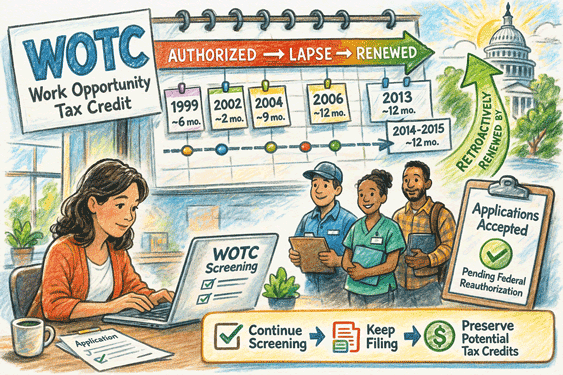
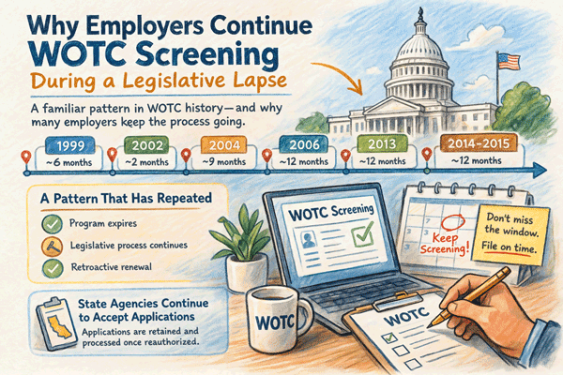
A Little History: This is Nothing New. The Work opportunity Tax Credit (WOTC) was created by the Small Business Job Protection Act of 1996. This Act authorized WOTC for a 12-month period. Then, in 1997, WOTC was re-authorized and extended for 9 months, followed by an additional 12 months in 1998. This process of expiration and re-authorization has been repeated by Congress nine times during the past 12 years.

Because of the political process, Congress has sometimes been delayed in its reauthorization of the WOTC program. In 2002, 2003 and 2006, the reauthorization was delayed as much 3, 10, and even 12 months after the program’s most recent authorization had expired. In each case, however, the program was then reauthorized retroactively back to the previous expiration date so that there has been no break in the continuity and availability of the tax credits.

Continued Screening and Processing vs. Losing Tax Credits. During these delays in reauthorization, the U.S. Department of Labor issues guidelines that have enabled employers and the government offices that administer the program to remain active in processing WOTC paperwork and applications. This has always involved some risk, however, since Congress is not obligated to renew the program.

On the other hand, employers who choose to delay the survey and application process loose their tax credits. They are lost because even during the temporary breaks in legislative authority, the program’s 28-day employee application deadline still applies. Employee applications submitted after 28 days are rejected by the WOTC program in each state.

Currently, we are experiencing a similar delay. The legislation that authorized major parts of the WOTC program expired on December 31, 2011. However, at about the same time, a very specialized bill was signed by President Obama that reauthorized and expanded the part of WOTC that generates tax credits when a business hires qualifying military veterans. This bill was called the VOW to Hire Heroes Act.

As a result of the VOW to Hire Heroes Act, some parts of WOTC are currently authorized while other parts are experiencing the now-common delay in reauthorization. As in all previous cases, friends in Congress are working to reauthorize the entire WOTC program. My firm is screening for ALL potential qualifiers influenced by the hope that the remaining employee-eligibility categories will also be reauthorized.

As a final note, Congressional reauthorization of WOTC has no impact on most state hiring credit programs. These remain effective and available even during the delay affecting WOTC.

For more information, see the Department of Labor’s Training and Employment Guidance Letter (TEGL) 15-11 dated January 24, 2012.


NEW WOTC Forms, Electronic & FAX Filing and Transition Relief

Wednesday, February 15th, 2012

Catching up with the VOW to Hire Heroes Act, which was signed by President Obama in November of last year, the Internal Revenue Service has issued an updated Form 8850 and some very important guidance.

Links for your convenience:  The new IRS Form 8850.  IRS 8850 Instructions.  IRS Notice 2012-13

Disconnected Youth: Although not unexpected, I should note that in preparing the updated IRS 8850 Pre-screening Notice, the IRS has removed the questions related to qualifying Disconnected Youth.  This category expired on December 31, 2010. 

We’ve been clinging to the hope that it would be added-back with the extension of WOTC.  I personally have not given up on that hope.  Also, if I am not mistaken, the Department of Labor’s current instructions to State Workforce Agencies still requires them to reserve disconnected youth applications on file pending future instructions.

Notice 2012-13: Notice 2012-13 provides guidance on a number of important issues and should not be overlooked.  I suggest a thorough reading.  Major topics covered include:

  • Background of the new veterans categories
  • Transition relief (a grace period extending the 28-day submission deadline for IRS 8850 for qualified veterans hired between November 22, 2011 and May 22, 2012)
  • The use of electronic signatures for IRS 8850
  • Signing or filing IRS 8850 by FAX transmission
  • Guidance for tax-exempt organizations claiming WOTC

Request for Comments: In addition to the guidance provided by the IRS on these topics, the IRS is also requesting comments about (1) alternative methods for certification of qualified veterans and (2)alternative methods of filing Form 8850.

In summary, with this notice the IRS has given us a lot to think about and a lot of work to do. 

DOL (Also) Issues New WOTC Instructions for Vow to Hire Heroes Act

Monday, December 12th, 2011

The following instructions are copied directly from the document recently published by the US Department of Labor.

Vow to Hire Heroes Act – Work Opportunity Tax Credit Provisions: Interim Instructions for State Workforce Agencies and Employers

On November 21, 2011, the President signed into law the “Vow to Hire Heroes Act”, which amends and expands the definition of Veteran target groups for the Work Opportunity Tax Credit (WOTC). These provisions became effective the day after the President signed the Act into law (November 22, 2011).

The Employment and Training Administration (ETA) is working to revise and issue ETA Forms 9061 and 9058, and update all other program-related materials, to reflect changes to the Veteran target groups. During this transition period until revised forms are issued, employers are instructed to continue to use the current ETA Form 9061.

When requesting certification for the Veteran target groups using ETA Form 9061, employers and consultants should do the following:

1) When using the hard copies of Form 9061, indicate in red at the top margin of the form the Veteran target group for which they are requesting certification.

2) When using an electronic form for the 9061 with those states that are fully automated, indicate in black at the top margin of the form the Veteran target group for which they are requesting certification.

Note: ETA will notify states with a date for the end of this transition period and the date when employers are to start using only the revised forms and program materials. State Workforce Agencies are to accept the current forms until additional guidance is provided by ETA.

3) Employers and consultants must continue to adhere to the “28-day timely filing” requirement.

4) Employers and consultants should follow any other instructions IRS may issue. States and Participating Agencies should continue to use the current ETA Form 9062 and follow its instructions, which already provide for the Veteran target groups.

State Workforce Agencies should continue to use ETA Form 9058, Report 1, until further ETA guidance.


Vow to Hire Heroes Act: DOL Publishes Summary of New WOTC Provisions

Monday, December 12th, 2011

Thank you to Rik Moore of the National Telecommuting Institute, Inc. for bringing this to my attention early last week.

The US Department of Labor has offered new guidance bringing into focus the WOTC provisions of the recently passed Vow to Hire Heroes Act of 2011.   A summary of WOTC-related provisions from the act has been published on the Department of Labor’s website.  The following is copied directly from that document.  Please download the entire document in order to see footnotes and introductory content not included here.

• Extends the current target group for Veterans receiving Supplemental Nutrition Assistance Program (SNAP) benefits with the same qualified wages cap ($6,000) and maximum tax credit ($2,400).

• Extends the current target group for Veterans with a service-connected disability with the same qualified wages cap ($12,000) and maximum tax credit ($4,800).

• Extends the current target group for Veterans with a service-connected disability unemployed for at least 6 months with the qualified wages cap increased to $24,000 and the maximum tax credit increased to $9,600.

• Establishes a new target group for unemployed Veterans, similar to the Recovery Act of 2009 unemployed Veteran group that expired on December 31, 2010:

o Veterans unemployed for at least 4 weeks with a qualified wages cap of $6,000 and maximum tax credit of $2,400.

o Veterans unemployed for at least 6 months with qualified wages cap of $14,000 and maximum tax credit of $5,600.

o State Workforce Agencies will certify veterans as meeting the required periods of unemployment based on receipt of unemployment insurance compensation.

Note: The 5-year period ending on the hiring day requirement that was part of the Recovery Act unemployed veteran group was rescinded.

• Qualified “tax-exempt” (i.e., 501(c)) organizations can now participate by hiring qualified veterans and are now eligible to claim the WOTC.

• These provisions became effective the day after the President signed the Vow to Hire Heroes Act into law, November 22, 2011, through December 31, 2012.

• The Vow to Hire Heroes Act does not extend any of the other (non-Veteran) WOTC target groups, which currently expire on December 31, 2011.


Now Is Time to Contact Congress – Include WOTC in Tax Extender

Wednesday, November 30th, 2011

If you or your clients would be adversely affected by the expiration of the WOTC program on December 31 (just one month away), then NOW is the time to contact your member of Congress.

You don’t have to speak with the member directly. Speak with the staff member that answers the phone. Send them a fax. Send them a letter. (Unless, you have an existing relationship with a specific member of your Congress person’s office, I don’t recommend relying on email.) Tell them your story and ask them to support including WOTC in the year-end tax extenders legislation.

Contact information for members of Congress is available at www.senate.gov and www.house.gov  or (202) 224-3121 or (202) 225-3121.  An online directory I recently discovered, provided by the Conservative Caucus appears to be a thorough resource also, including fax numbers, email addresses, and links directly to each Member’s website.  http://www.conservativeusa.org/mega-cong.htm

Below are some informational points that I sent to my Congressman Dan Lungren just this morning. Since we already know each other, I sent my correspondence directly to Congressman Lungren’s District Director in California. She very kindly responded to my e-mail in less than twenty minutes.

“I am going to forward your email to our Legislative Counsel in DC as he will brief the Congressman on the legislation and the latest developments.”

As the year’s end approaches, Tax Extenders are, or will soon become a topic of discussion for Members of Congress. WOTC will be included in that discussion as one of the tax provisions to be extended.

I have three points that the Congressman may find important.

1. All Non-Veteran Job Categories Will Expire. While the VOW to Hire Heroes Act extended through 2012 the WOTC categories for veterans, all other WOTC job categories are still slated to expire on December 31. The categories for disabled workers, at-risk youth, people living in distressed communities, etc. will all expire abruptly THIS YEAR unless WOTC is included in a tax extender bill.

2. Ending WOTC = Crushing Tax Increase on Employers: An abrupt end to these WOTC categories will result in a large tax increase to employers who have incorporated WOTC’s public-private sector partnership into their hiring practices.

3. Tax Extender Now – Followed Later By Due Diligence. The future of the WOTC program ought to be determined by a reasoned discussion in Congress – - not by letting it slip through the cracks at year-end. The recent VOW to Hire Heroes Act demonstrates that the effectiveness of WOTC is still recognized on both sides of the aisle — after 15 years in operation! If the rest of the WOTC program is to be discontinued, it should be done in an orderly way that allows employers to anticipate the change . . . after Congress has given due consideration to the issues.

Bottom Line: extend the entire WOTC program now for at least 12 months, giving Congress time to discuss its merits in 2012.

For my readers, I would also point out that if WOTC is not extended by the end of the year, it is still far from over.  There will be additional opportunities for reauthorization in 2012.  Although inconvenient, this would not be at all unusual for the WOTC program.

WOTC has been extended 7 times already since it’s origination in 1996.  Frequently, that process has involved “retroactive” reauthorization during the calendar year after its technical expiration.  In each such case, business continued as usually, with the exception that WOTC certification offices nationwide had to keep back their certifications until the reauthorization legislation finally went through.

My point: Be diligent now, but don’t worry yet.

President Obama Signs Veterans’ Hiring Credit Bill

Monday, November 21st, 2011

The VOW to Hire Heroes Act was signed today by President Obama.  (see Business Week article from today.)  As previously mentioned, this bill expands the eligible-veterans categories under the Work Opportunity Tax Credit (WOTC) program and extends the new categories through December 31, 2012. Unless the legislative language was modified prior to final passage, my understanding is that the new WOTC categories will become effective immediately.

Employers now have a job to do – update their WOTC screening tools to identify and document new hires who are members of the newly-targeted veteran groups. Any immediate changes, however, should be made with the understanding that the Department of Labor and IRS will also be updating WOTC regulations, documentation standards, and official WOTC forms. The last time significant changes were made to the WOTC program, it took months and multiple attempts for the government to finalize these changes.

In this regard, I should note that the bill includes language granting some degree of discretion to the Department of Labor when it comes to defining the documentation  requirements for the new categories.  On its face, the bill looks to a veteran’s unemployment insurance compensation history to document the required level of unemployment.  We hope, however, that other approaches will also be approved since not every unemployed veteran will necessarily have been eligible for unemployment insurance compensation.

Now that this bill has been signed by the President, I feel good about digging into the details of its legislative language. Stay tuned for further exploration and explanations.