Work Opportunity Tax Credit

...now browsing by tag


Latest News on Payroll Tax Cut Extension and WOTC Renewal

Wednesday, February 15th, 2012

I thought you might appreciate the following excerpt from a recent email update I received from WOTC Coalition President Paul Suplizio.  Some of this has been reported in the news but Paul’s perspective adds something important.  I am re-publishing this with his permission.

In a statement [Monday], Speaker John Boehner and Majority Leader Eric Cantor said they will no longer require offsets for the $100 billion cost to extend the payroll tax cut to the end of the year, and are preparing a bill that will extend the payroll tax cut separately if the conference reaches no agreement, leaving the conference to continue working on unemployment insurance and Medicare doctors’ payments.

The conference committee is being notified of this new Republican position, which means $100 billion of the total $160 billion cost of the payroll bill would not have to be offset.

The conferees still have time to reach agreement on a total package, but if they don’t the Speaker is free to make the effort to pass a stand-alone bill extending the payroll tax only. This would remove payroll tax as a partisan issue, but the Speaker is likely to need Democratic support because of the roughly ninety Republicans who would not vote to increase the deficit.

Senator Reid is expected to make the extenders part of the bill he has said he will introduce if the conference bogs down. He will have the option to bring it to a vote or attach it to any stand-alone payroll bill that passes the House.

Unemployment compensation and doc fix remain “must do” issues, even if payroll tax is passed separately—thus we continue to work for the tax extenders to be added to HR 3630 in conference.

If $40 billion for tax extenders is added, the total requiring offset would be $100 billion for unemployment insurance, doctors’ fix, and the tax extenders. Democrats are arguing unemployment insurance should not be offset, and a good case can be made for not offsetting the tax extenders.

Comments: The Republican leadership’s concession on not requiring a budget offset to the “cost” of the payroll-tax-cut extension reduces the total amount of offsets needed to pass all of the priority items.  One of those priority items is the tax extenders, which will presumably include WOTC.

What this boils down to is that we are likely to at least see legislation soon with tax extenders attached.  Whether Congress can pass it, of course, is a separate question.  Nothing is certain and the political environment remains volatile.

National Restaurant Association Turns Up WOTC Heat on Congress

Tuesday, February 7th, 2012

In a letter today addressed to all members of Congress, the National Restaurant Association called on legislators to extend the Work Opportunity Tax Credit (WOTC) program and a 15-year depreciation allowance for certain kinds of assets important to the restaurant industry. 

The letter, signed by Scott DeFife, Executive Vice President, Policy and Government Affairs, begins with the following statement.

On behalf of the National Restaurant Association, I am writing to strongly urge Congress to prospectively and retroactively extend tax provisions that expired at the end of 2011.  Two particular provisions of significance to the restaurant industry are: 15-year depreciation for restaurants and the Work Opportunity Tax Credit (WOTC). We urge consideration of these measures as part of the discussions on extending through 2012 the payroll-tax reduction that expires at the end of this month.

Read the entire letter here.

Stay tuned.  There is more to come about the ongoing House-Senate conference currently seeking an agreement on extending the 2011 payroll-tax cut.   It’s not just the National Restaurant Association that is urging legislators to address WOTC and other tax extenders with this bill.

Senators Baucus and Reid — Tax Extenders Should Be Included In Payroll Tax Cut Deal

Tuesday, January 24th, 2012

Negotiations are on again to extend the 2011 payroll tax cut until the end of 2012.  The House-Senate Conference met on Tuesday — the first time this year — and the road to an agreement appears rocky.  Optimism is alive – but there are also some big disagreements to sort through.

Both sides of the discussion agree that a deal must be made before the end of February when the current 2-month extension expires.

Of great interest to us is the question of the other tax extenders. The House of Representative’s payroll tax cut proposal does not include the tax extenders or WOTC.  However, Senate Majority Leader Harry Reid and Senate Finance Committee Chairman Max Baucus are reported to have both suggested today that the Conference should examine the expired tax provisions at this time.  (See today’s article in The Hill, scroll down to end.)

Democrats are looking to possibly tuck other provisions into a payroll-tax deal. On Tuesday, Baucus and Reid both suggested that the conference committee examine tax provisions that expired at the end of 2011 — the so-called tax extenders.

On the other hand,

The [House] Ways and Means Committee chairman [Republican Dave Camp] also told reporters after the meeting that conferees should first try to resolve core issues — such as the payroll-tax cut, unemployment benefits and the Medicare “doc fix” — and leave other issues until the end of the negotiations.

 “I think initially we need to have a pretty strict scope of conference,” Camp said. “Let’s figure out what we have been tasked with doing.”

Representative Camp is well aware of WOTC and has been the focus of significant lobbying efforts.  We are keeping our fingers crossed.  Keep your phone and fax machine ready.  The conference members need to hear from you.

More from the New York Times.

WOTC – Calm Before the Storm in Congress

Tuesday, January 10th, 2012

Is it the calm before a storm? Congress is on vacation. The Senate is scheduled to reconvene on January 23rd. The House on January 17th.

Before members of Congress left for the holiday in December, they had tumultuously agreed on a 2-month extension of the 2011 payroll tax cut and left many expiring tax items floating into limbo. The Work Opportunity Tax Credit, of course, is counted among these unfinished items.

Although nothing has made significant news yet, the conference that was promised last month by House and Senate leaders is already busy behind the scenes. According to Paul Suplizio, lobbyist and President of the WOTC Coalition, conferees for the Senate and House respectively are in discussion with their own members but not yet with each other. The first meeting between Senate and House conferees will likely take place next week.

The goal of the conference is to hammer out a compromise that will allow Congress to pass a full-year extension of the payroll tax cut, in addition to other high-priority items. They need to do it before the end of February when the 2-month extension expires.

Our goal is to include WOTC and other tax items in that legislation. The conferees, however, face historically difficult and stressful circumstances. WOTC remains in a very precarious situation. If the tax extenders do not make it into the anticipated payroll tax cut bill, it will be difficult to see another vote on these items until after the November election.

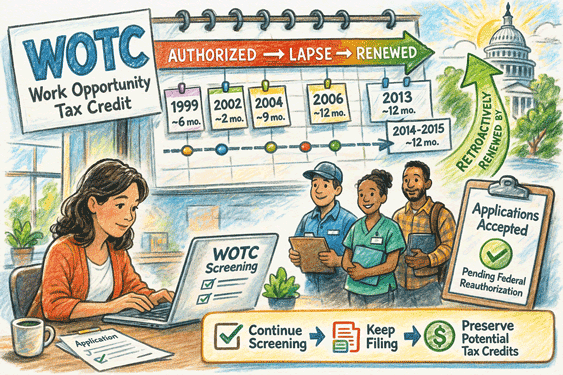
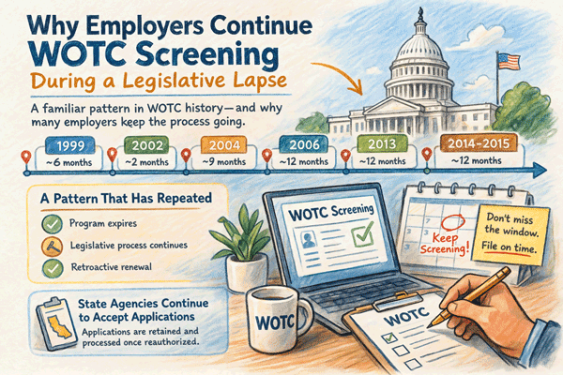
During the past 15 years, WOTC has expired and been renewed at least 7 times. Three of these renewals took place well into the next calendar years — as much as 11 months after expiration.

If the program is not renewed in February, business will continue as usual. Employers will continue to screen for all of the WOTC target groups. The State Workforce Agencies, however, will receive instructions to place a hold on WOTC employee certifications — except for those who qualify under the military veteran categories, which have been extended already through December 2012.

Then, as soon as the renewal legislation is passed, the State Workforce Agencies will complete and issue the rest of the outstanding WOTC employee certifications.  We’ve lived through it before. But let’s hope it doesn’t come to that.

My office will be following the lead of the WOTC Coalition by contacting key legislators during the upcoming weeks. I’ll post new information and guidance as it becomes available.

Please feel welcome to contact me personally if you would like to discuss (or simply commiserate). vah@WOTCPlanet.com

Renewal of WOTC and Payroll Tax Cut Still Possible This Year

Monday, December 19th, 2011

If you’ve been following the news during the past few days, you might be aware that Congressional leaders are sparring over legislation to extend the existing payroll tax cut. Over the weekend, the Senate rejected the House’s proposal and responded with a proposed 2-month extension, obviously intended to buy time for further negotiations.

Neither version of the legislation included WOTC nor other sought after tax-extenders. This is not, however, the end of the game.

The limited 2-month extension is not looked upon favorably by the House Republican leadership, which is demanding a full year.  The House is scheduled to vote on the bill this evening.

According to Bloomberg,

With the House set to return to Washington [Monday], Republican leaders are studying their options, Laena Fallon, a spokeswoman for House Majority Leader Eric Cantor, a Virginia Republican, said in an e-mail.

When the House meets [Monday evening], it will either vote to amend the Senate-passed measure “so that it is responsible and in line with the needs of hard-working taxpayers and middle class families” or vote to appoint representatives to a House-Senate conference to reconcile differences between the two chambers, she said.

Got that? The House will either amend the Senate bill and return it. Or it will vote to appoint a conference with the Senate to negotiate revisions. If the House does call for a conference, the Senate leadership (aka Senator Harry Reid) could accept or reject it. But rejecting it in that case would result in a tax increase on January 1 as the payroll tax reduction expires. Not a pretty political sight.

If a conference is called, Paul Suplizio, President of the WOTC Coalition sees still another opportunity to get WOTC and other tax extenders passed this year.

“If it gets to a conference, Ways and Means Chairman Dave Camp of Michigan would be one of the conferees for the House (he was floor manager for the House bill) and Finance Chairman Max Baucus of Montana a likely conferee for the Senate.”

“Chairman Camp has been the target of much of our lobbying and knows the situation of WOTC and the extenders. Senator Baucus has been a champion for including WOTC and the other extenders in the payroll bill.”

If you have any opportunity to encourage Representative Dave Camp or Senator Max Baucus, now is the time. Senator Harry Reid and his friends in the Whitehouse should also be contacted.  Senator Reid will likely require encouragement from the Whitehouse to include WOTC and other tax extenders in any negotiated resolution to this legislative conflict.

DOL (Also) Issues New WOTC Instructions for Vow to Hire Heroes Act

Monday, December 12th, 2011

The following instructions are copied directly from the document recently published by the US Department of Labor.

Vow to Hire Heroes Act – Work Opportunity Tax Credit Provisions: Interim Instructions for State Workforce Agencies and Employers

On November 21, 2011, the President signed into law the “Vow to Hire Heroes Act”, which amends and expands the definition of Veteran target groups for the Work Opportunity Tax Credit (WOTC). These provisions became effective the day after the President signed the Act into law (November 22, 2011).

The Employment and Training Administration (ETA) is working to revise and issue ETA Forms 9061 and 9058, and update all other program-related materials, to reflect changes to the Veteran target groups. During this transition period until revised forms are issued, employers are instructed to continue to use the current ETA Form 9061.

When requesting certification for the Veteran target groups using ETA Form 9061, employers and consultants should do the following:

1) When using the hard copies of Form 9061, indicate in red at the top margin of the form the Veteran target group for which they are requesting certification.

2) When using an electronic form for the 9061 with those states that are fully automated, indicate in black at the top margin of the form the Veteran target group for which they are requesting certification.

Note: ETA will notify states with a date for the end of this transition period and the date when employers are to start using only the revised forms and program materials. State Workforce Agencies are to accept the current forms until additional guidance is provided by ETA.

3) Employers and consultants must continue to adhere to the “28-day timely filing” requirement.

4) Employers and consultants should follow any other instructions IRS may issue. States and Participating Agencies should continue to use the current ETA Form 9062 and follow its instructions, which already provide for the Veteran target groups.

State Workforce Agencies should continue to use ETA Form 9058, Report 1, until further ETA guidance.


Vow to Hire Heroes Act: DOL Publishes Summary of New WOTC Provisions

Monday, December 12th, 2011

Thank you to Rik Moore of the National Telecommuting Institute, Inc. for bringing this to my attention early last week.

The US Department of Labor has offered new guidance bringing into focus the WOTC provisions of the recently passed Vow to Hire Heroes Act of 2011.   A summary of WOTC-related provisions from the act has been published on the Department of Labor’s website.  The following is copied directly from that document.  Please download the entire document in order to see footnotes and introductory content not included here.

• Extends the current target group for Veterans receiving Supplemental Nutrition Assistance Program (SNAP) benefits with the same qualified wages cap ($6,000) and maximum tax credit ($2,400).

• Extends the current target group for Veterans with a service-connected disability with the same qualified wages cap ($12,000) and maximum tax credit ($4,800).

• Extends the current target group for Veterans with a service-connected disability unemployed for at least 6 months with the qualified wages cap increased to $24,000 and the maximum tax credit increased to $9,600.

• Establishes a new target group for unemployed Veterans, similar to the Recovery Act of 2009 unemployed Veteran group that expired on December 31, 2010:

o Veterans unemployed for at least 4 weeks with a qualified wages cap of $6,000 and maximum tax credit of $2,400.

o Veterans unemployed for at least 6 months with qualified wages cap of $14,000 and maximum tax credit of $5,600.

o State Workforce Agencies will certify veterans as meeting the required periods of unemployment based on receipt of unemployment insurance compensation.

Note: The 5-year period ending on the hiring day requirement that was part of the Recovery Act unemployed veteran group was rescinded.

• Qualified “tax-exempt” (i.e., 501(c)) organizations can now participate by hiring qualified veterans and are now eligible to claim the WOTC.

• These provisions became effective the day after the President signed the Vow to Hire Heroes Act into law, November 22, 2011, through December 31, 2012.

• The Vow to Hire Heroes Act does not extend any of the other (non-Veteran) WOTC target groups, which currently expire on December 31, 2011.


Urgent WOTC Update – Inform Your Republican Senators Now

Tuesday, December 6th, 2011

Our friend Paul Suplizio, President of the WOTC Coalition, issued two urgent updates this morning from Washington DC.  The immediate extension of WOTC and other tax incentive programs faces what amounts to a precarious opportunity.

As the calendar year winds to a close, opportunities to extend the WOTC program are few in number. The good news is Senate Majority Leader Harry Reid has announced his intention that Congress will NOT adjourn until tax extenders are done.  He made this announcement in a news conference after the Senate Democrats’ most recent weekly luncheon.

“There are five things we’ve got to do, the Omnibus (bill to fund the government), payroll tax, unemployment compensation, doc fix, and tax extenders.”

 What to do Right Now:
According to Mr. Suplizio, if the tax extenders are not passed before December 31, there is a strong possibility they won’t be passed until after the elections next fall.  For this, and other reasons:

“It’s imperative we now work to persuade Senate Minority Leader Mitch McConnell to commit to enacting the tax extenders before adjournment. Please concentrate urgently on your Republican senatorial contacts. . . .”

Specifically,

  1. Inform your Republican contacts in the Senate about Majority Leader Harry Reid’s goal to pass tax extenders before adjournment
  2. Urge Senate Republicans to support the tax extenders
  3. Urge them specifically to talk with Senate Minority Leader Mitch McConnell and Republican Whip Senator Jon Kyl about the importance of including tax extenders in whatever bills emerge from their negotiations with Senate Democrats.


Now Is Time to Contact Congress – Include WOTC in Tax Extender

Wednesday, November 30th, 2011

If you or your clients would be adversely affected by the expiration of the WOTC program on December 31 (just one month away), then NOW is the time to contact your member of Congress.

You don’t have to speak with the member directly. Speak with the staff member that answers the phone. Send them a fax. Send them a letter. (Unless, you have an existing relationship with a specific member of your Congress person’s office, I don’t recommend relying on email.) Tell them your story and ask them to support including WOTC in the year-end tax extenders legislation.

Contact information for members of Congress is available at www.senate.gov and www.house.gov  or (202) 224-3121 or (202) 225-3121.  An online directory I recently discovered, provided by the Conservative Caucus appears to be a thorough resource also, including fax numbers, email addresses, and links directly to each Member’s website.  http://www.conservativeusa.org/mega-cong.htm

Below are some informational points that I sent to my Congressman Dan Lungren just this morning. Since we already know each other, I sent my correspondence directly to Congressman Lungren’s District Director in California. She very kindly responded to my e-mail in less than twenty minutes.

“I am going to forward your email to our Legislative Counsel in DC as he will brief the Congressman on the legislation and the latest developments.”

As the year’s end approaches, Tax Extenders are, or will soon become a topic of discussion for Members of Congress. WOTC will be included in that discussion as one of the tax provisions to be extended.

I have three points that the Congressman may find important.

1. All Non-Veteran Job Categories Will Expire. While the VOW to Hire Heroes Act extended through 2012 the WOTC categories for veterans, all other WOTC job categories are still slated to expire on December 31. The categories for disabled workers, at-risk youth, people living in distressed communities, etc. will all expire abruptly THIS YEAR unless WOTC is included in a tax extender bill.

2. Ending WOTC = Crushing Tax Increase on Employers: An abrupt end to these WOTC categories will result in a large tax increase to employers who have incorporated WOTC’s public-private sector partnership into their hiring practices.

3. Tax Extender Now – Followed Later By Due Diligence. The future of the WOTC program ought to be determined by a reasoned discussion in Congress – - not by letting it slip through the cracks at year-end. The recent VOW to Hire Heroes Act demonstrates that the effectiveness of WOTC is still recognized on both sides of the aisle — after 15 years in operation! If the rest of the WOTC program is to be discontinued, it should be done in an orderly way that allows employers to anticipate the change . . . after Congress has given due consideration to the issues.

Bottom Line: extend the entire WOTC program now for at least 12 months, giving Congress time to discuss its merits in 2012.

For my readers, I would also point out that if WOTC is not extended by the end of the year, it is still far from over.  There will be additional opportunities for reauthorization in 2012.  Although inconvenient, this would not be at all unusual for the WOTC program.

WOTC has been extended 7 times already since it’s origination in 1996.  Frequently, that process has involved “retroactive” reauthorization during the calendar year after its technical expiration.  In each such case, business continued as usually, with the exception that WOTC certification offices nationwide had to keep back their certifications until the reauthorization legislation finally went through.

My point: Be diligent now, but don’t worry yet.

President Obama Signs Veterans’ Hiring Credit Bill

Monday, November 21st, 2011

The VOW to Hire Heroes Act was signed today by President Obama.  (see Business Week article from today.)  As previously mentioned, this bill expands the eligible-veterans categories under the Work Opportunity Tax Credit (WOTC) program and extends the new categories through December 31, 2012. Unless the legislative language was modified prior to final passage, my understanding is that the new WOTC categories will become effective immediately.

Employers now have a job to do – update their WOTC screening tools to identify and document new hires who are members of the newly-targeted veteran groups. Any immediate changes, however, should be made with the understanding that the Department of Labor and IRS will also be updating WOTC regulations, documentation standards, and official WOTC forms. The last time significant changes were made to the WOTC program, it took months and multiple attempts for the government to finalize these changes.

In this regard, I should note that the bill includes language granting some degree of discretion to the Department of Labor when it comes to defining the documentation  requirements for the new categories.  On its face, the bill looks to a veteran’s unemployment insurance compensation history to document the required level of unemployment.  We hope, however, that other approaches will also be approved since not every unemployed veteran will necessarily have been eligible for unemployment insurance compensation.

Now that this bill has been signed by the President, I feel good about digging into the details of its legislative language. Stay tuned for further exploration and explanations.